


Spotlighting environmental justice and urban design for Earth Day
These days, celebrating Earth Day can feel like a macabre experience. Climate change continues to evolve at a rapid pace, increasingly affecting more and more of the planet. This year to mark Earth Day, we focus on hope—and what we can do in our built environments to improve our one planet.
Read on to explore books on sustainable urban design and environmental justice, and sign up for our newsletter to hear more from the Press.

Inventing Future Cities by Michael Batty
We cannot predict future cities, but we can invent them. Cities are largely unpredictable because they are complex systems that are more like organisms than machines. Neither the laws of economics nor the laws of mechanics apply; cities are the product of countless individual and collective decisions that do not conform to any grand plan. They are the product of our inventions; they evolve. In Inventing Future Cities, Michael Batty explores what we need to understand about cities in order to invent their future.
“Mike Batty’s new book is a tour de force meta-narrative of both the trends and components of urbanism at the start of the 21st century and one that should be read by all those with an interest in cities.” —Urban Analytics and City Science

Our Urban Future: An Active Learning Guide to Sustainable Cities by Sabina Shaikh and Emily Talen
While the problem of urban sustainability has long been a subject of great scholarly interest, there has, until now, been no single source providing a multi-disciplinary, exhaustive view of how it can be effectively taught. Filling this gap, Our Urban Future uses active learning techniques to comprehensively relate the theory of urban sustainability and the what, why, and how of sustainable cities. This practical, pedagogically rich textbook concisely covers all the key subjects of the field, including ecosystem services and transects, the internal design and patterning of urban elements, how cities mitigate and adapt to climate change, and questions of environmental justice. It functions as both an illuminating roadmap and an active reference to which any student of sustainability can turn to find essential resources and perspectives in pursuit of creating sustainable cities.

Shifting Gears: Toward a New Way of Thinking about Transportation by Susan Handy
Excruciating traffic jams. Struggling transit agencies. An epidemic of pedestrian fatalities. It is clear that transportation is not working in the United States and that we need to rethink our approach. In Shifting Gears, Susan Handy provides an in-depth history of the ideas embedded in American transportation policy and the emergence of new ways of thinking that could give us better transportation options. Weaving in bits of her own personal narrative, Handy gives readers a deeper and clearer understanding of our transportation system and the roots of its successes and failures.
“With accessible writing, academic rigor, and the right sense of the absurd, Susan Handy explains how American transport planning got us into this mess, and the path to get us out.” —Jeffrey Tumlin, Director, San Francisco Municipal Transportation Agency

Form and Flow: The Spatial Politics of Urban Resilience and Climate Justice by Kian Goh
Cities around the world are formulating plans to respond to climate change and adapt to its impact. Often, marginalized urban residents resist these plans, offering “counterplans” to protest unjust and exclusionary actions. In this book, Kian Goh examines climate change response strategies in three cities—New York, Jakarta, and Rotterdam—and the mobilization of community groups to fight the perceived injustices and oversights of these plans. Looking through the lenses of urban design and socioecological spatial politics, Goh reveals how contested visions of the future city are produced and gain power.
“A great look into the near future for these three cities—New York City, Rotterdam, and Jakarta—and a warning to other cities.” —Choice

Cycling for Sustainable Cities by Ralph Buehler and John Pucher
Cycling is the most sustainable means of urban travel, practical for most short- and medium-distance trips—commuting to and from work and school, shopping, visiting friends—as well as for recreation and exercise. Cycling promotes physical, social, and mental health, helps reduce car use, enhances mobility and independence, and is economical for both public and personal budgets. Cycling should be made feasible for everyone and not limited to especially fit, daring, well-trained cyclists riding expensive bicycles. Cycling for Sustainable Cities shows how to make city cycling safe, practical, and convenient for all ages and abilities.

Grounding Urban Natures: Histories and Futures of Urban Ecologies edited by Henrik Ernstson and Sverker Sörlin
The global discourse around urban ecology tends to homogenize and universalize, relying on such terms as “smart cities,” “eco-cities,” and “resilience,” and proposing a “science of cities” based largely on information from the Global North. Grounding Urban Natures makes the case for the importance of place and time in understanding urban environments. Rather than imposing a unified framework on the ecology of cities, the contributors use a variety of approaches across a range of locales and timespans to examine how urban natures are part of—and are shaped by—cities and urbanization. Grounding Urban Natures offers case studies from cities on five continents that demonstrate the advantages of thinking comparatively about urban environments.

Bridging Silos: Collaborating for Environmental Health and Justice in Urban Communities by Katrina Smith Korfmacher
Low-income and marginalized urban communities often suffer disproportionate exposure to environmental hazards, leaving residents vulnerable to associated health problems. Community groups, academics, environmental justice advocates, government agencies, and others have worked to address these issues, building coalitions at the local level to change the policies and systems that create environmental health inequities. In Bridging Silos, Katrina Smith Korfmacher examines ways that communities can collaborate across systems and sectors to address environmental health disparities, with in-depth studies of three efforts to address long-standing environmental health issues: childhood lead poisoning in Rochester, New York; unhealthy built environments in Duluth, Minnesota; and pollution related to commercial ports and international trade in Southern California.
“Bridging Silos offers hope at a time of federal inaction on pressing environmental and public health issues.” —Gina McCarthy, former U.S. Environmental Protection Agency Administrator
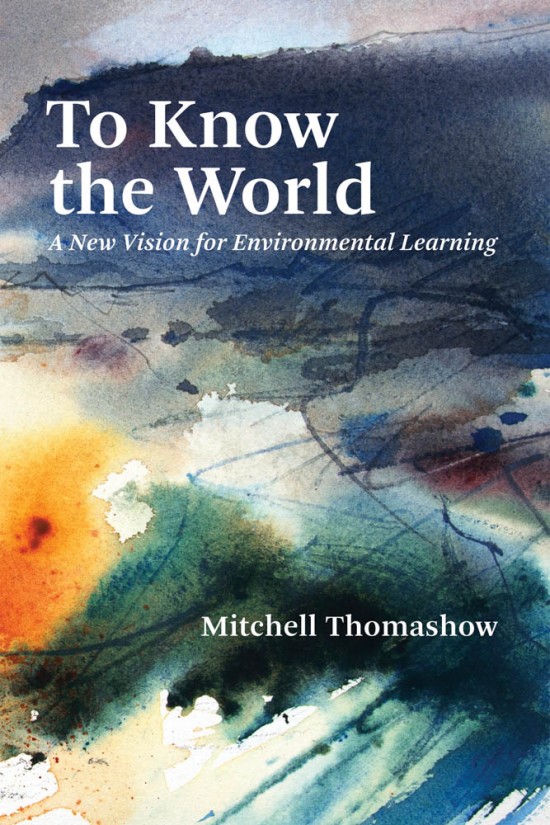
To Know the World: A New Vision for Environmental Learning by Mitchell Thomashow
How can we respond to the current planetary ecological emergency? In To Know the World, Mitchell Thomashow proposes that we revitalize, revisit, and reinvigorate how we think about our residency on Earth. First, we must understand that the major challenges of our time—migration, race, inequity, climate justice, and democracy—connect to the biosphere. Traditional environmental education has accomplished much, but it has not been able to stem the inexorable decline of global ecosystems. Thomashow, the former president of a college dedicated to sustainability, describes instead environmental learning, a term signifying that our relationship to the biosphere must be front and center in all aspects of our daily lives. In this illuminating book, he provides rationales, narratives, and approaches for doing just that.
“This book, so rich in insight and evocative in style, will become a classic as its message is so critical to our shared planetary future.” —Mary Evelyn Tucker, Yale University; co-author, Journey of the Universe

Just Urban Design: The Struggle for a Public City edited by Kian Goh, Anastasia Loukaitou-Sideris and Vinit Mukhija
Scholars who write about justice and the city rarely consider the practices and processes of urban design, while discourses on urban design often neglect concerns about justice. The editors of Just Urban Design take the position that urban design interventions have direct and important implications for justice in the city. The contributions in this volume contextualize the state of knowledge about urban design for justice, stress inclusivity as the key to justice in the city, affirm community participation and organizing as cornerstones of greater equity, and assert that a just urban design must center and privilege our most marginalized individuals and communities.

Co-Cities: Innovative Transitions toward Just and Self-Sustaining Communities by Sheila R. Foster and Christian Iaione
The majority of the world’s inhabitants live in cities, but even with the vast wealth and resources these cities generate, their most vulnerable populations live without adequate or affordable housing, safe water, healthy food, and other essentials. And yet, cities also often harbor the solutions to the inequalities they create, as this book makes clear. With examples drawn from cities worldwide, Co-Cities outlines practices, laws, and policies that are presently fostering innovation in the provision of urban services, spurring collaborative economies as a driver of local sustainable development, and promoting inclusive and equitable regeneration of blighted urban areas.
“Since their emergence over 10,000 years ago, cities have been a piece of shared infrastructure. In light of today’s technological advances, this book compellingly advances the idea of the city as a commons.” —Carlo Ratti, Professor of Urban Technologies, MIT; Planning Director, MIT Senseable City Lab

Urban Humanities: New Practices for Reimagining the City by Dana Cuff, Anastasia Loukaitou-Sideris, Todd Presner, Maite Zubiaurre and Jonathan Jae-an Crisman
Urban humanities is an emerging field at the intersection of the humanities, urban planning, and design. It offers a new approach not only for understanding cities in a global context but for intervening in them, interpreting their histories, engaging with them in the present, and speculating about their futures. This book introduces both the theory and practice of urban humanities, tracing the evolution of the concept, presenting methods and practices with a wide range of research applications, describing changes in teaching and curricula, and offering case studies of urban humanities practices in the field.
“Urban Humanities allows us to reimagine the cities with a heightened sense of engagement for the cities in which we live and engage with.” —Catherine Opie, Professor of Photography, UCLA